
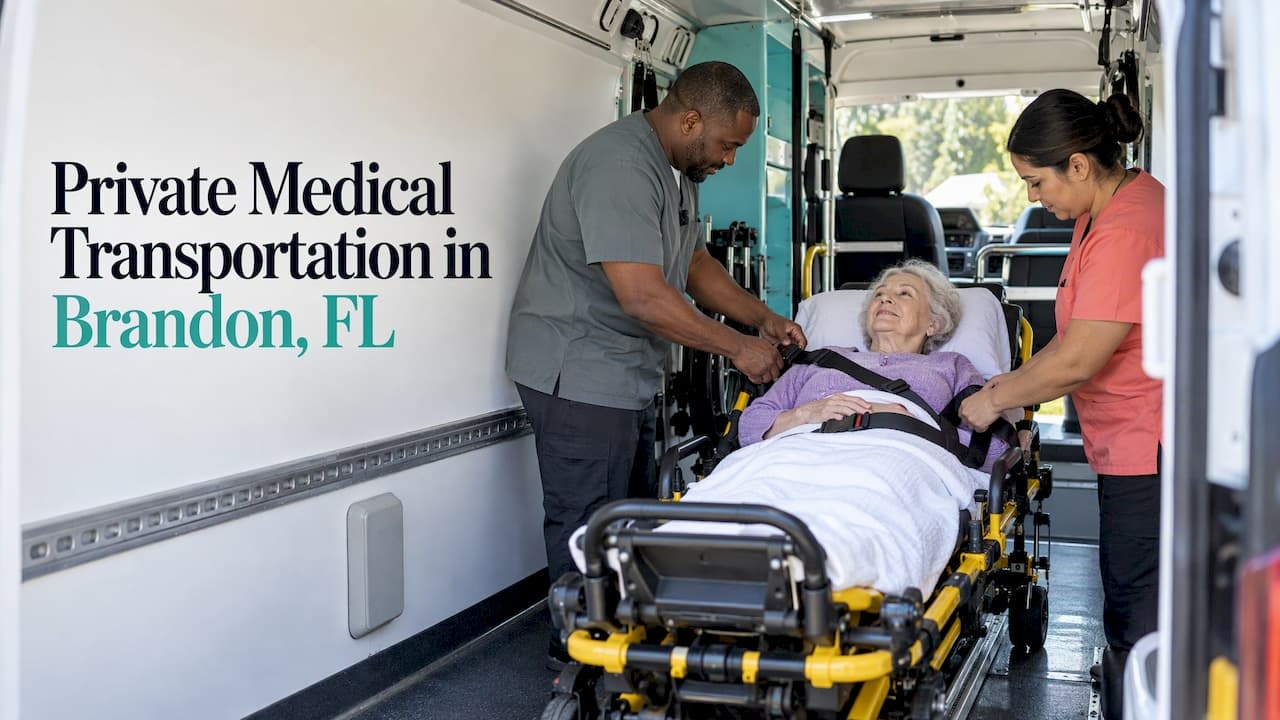
Private medical transportation is a pre-booked, non-emergency ride for someone who cannot safely travel by car, taxi or rideshare. The passenger usually uses a wheelchair or needs to lie on a stretcher. The ride is paid for directly by the passenger, a family member or a facility, and it is not billed to an insurer. In Brandon and greater Hillsborough County, it is how many families get a parent home from the hospital, into rehab, or to dialysis three times a week. This guide explains how to match the ride to the person, what to confirm before pickup, and what shapes the price.
TL;DR
- Private medical transportation covers non-emergency wheelchair and stretcher rides, booked and paid for directly, for discharges, transfers, dialysis and appointments.
- Choose the vehicle by how the passenger can sit, transfer and move. Choose the assistance level by how much help they need getting from the bed to the destination.
- Give the booker the pickup and drop-off, appointment time, mobility device details, and any special needs. This avoids a mismatched vehicle on the day.
- Medicare and Medicaid have strict rules for covered transport. We are private-pay only and do not bill either program.
- We provide a two-person crew on every stretcher trip, and bedside-to-bedside help including facility entry.
Table of Contents
- What private medical transportation is
- Wheelchair, stretcher or something else
- Levels of assistance: curb, door, hand-to-hand
- What affects the cost of a private-pay ride
- What to have ready when you book
- Preparing for pickup
- Our view from the crew
- Book a ride with Brandon Stretcher Transport
- Medicare, Medicaid and private-pay rides
- FAQ
- Sources
What private medical transportation is
There are three broad ways to move a person with limited mobility. An ambulance is for patients who need medical care or observation on the way. An ordinary car, taxi or rideshare is for people who can walk, or can transfer into a seat with little help. Private medical transportation sits between the two. It serves people who cannot use a regular vehicle safely but do not need a clinician treating them en route.
Government rules draw the same line. CMS says Medicare ambulance coverage is limited to patients whose condition makes other transportation unsafe, and that bed confinement alone is not enough to qualify. The Oregon Health Authority treats wheelchair and stretcher vehicles as mobility solutions, and reserves ambulances for patients who need care or observation from a health professional.
That gap is large in practice. A person recovering from a hip fracture, a dialysis patient who is exhausted after treatment, or someone with advanced dementia who cannot manage a car seat may all need physical help and the right equipment. None of them is in an emergency. Private medical transportation is built for exactly this.
If the passenger needs medical treatment or monitoring during the trip, that is an ambulance situation. Ask the discharging physician or nurse if you are unsure which category applies. They know the patient's condition and can tell you what level of transport is appropriate.
Wheelchair, stretcher or something else
The vehicle should match what the passenger can do, not what is most convenient to book. Virginia's Medicaid transportation handbook gives a clear ladder. It assigns ambulatory taxi service to riders who can enter and exit a vehicle on their own, wheelchair vans to those who cannot transfer safely, and van-stretcher service to people who need a stretcher but no care or monitoring. Ambulance service is for stretcher patients who need care or monitoring.

Wheelchair transportation
Wheelchair transport suits someone who can sit upright for the whole trip but cannot step into a car. Wheelchair rides use lift-equipped vehicles, and the Oregon manual notes they are generally door-to-door, with drivers sometimes collecting a client inside the home and escorting them to the destination. Typical cases include recurring dialysis, physical therapy, specialist visits, and a trip home from an outpatient procedure.

Stretcher transportation
Stretcher transport is for passengers who cannot sit upright safely. Oregon defines a stretcher car as a vehicle carrying a client prone or supine when they cannot sit up but do not need medical care or observation. Common situations include discharge from a hospital to a skilled nursing facility, a move from rehab to home, or a bed-bound patient who has a medical appointment.
On every stretcher trip we send a dedicated two-person crew. One person is never left to manage the transfer, the securement and the passenger's comfort alone.
Bariatric transportation
Passengers who need extra width or weight capacity need equipment and crew planning that fit their size. We quote bariatric transport individually, so the price reflects the actual trip and the actual needs.
How providers decide the right level
Umpqua Health's 2026 rider guide says the ride level is assessed by looking at walking and mobility-device use, the ability to move safely and perform daily activities, the need for an attendant, physical or mental conditions affecting safe travel, and the support required. You can run the same checklist yourself:
- Can the passenger sit upright for the full trip, including turns and stops?
- Can they stand and pivot, or do they need a lift or a full-body transfer?
- Do they need someone with them who can steady, reassure or redirect them?
- Does a physical or cognitive condition make an ordinary vehicle unsafe?
- Will they need any medical care along the way? If yes, speak to the care team about an ambulance.
Levels of assistance: curb, door, hand-to-hand
Two trips with the same vehicle can feel very different depending on how far the crew goes with the passenger. Public transportation programs describe three levels, and Virginia's handbook defines curb-to-curb, door-to-door and hand-to-hand assistance. Umpqua Health's guide describes the same three levels.
| Level | What it means in practice | Who it suits |
|---|---|---|
| Curb-to-curb | The vehicle picks up and drops off at the curb. The passenger gets to and from the door alone. | Passengers who are independent once they reach the vehicle |
| Door-to-door | The driver helps between the vehicle and the door. | Passengers who need help with steps or thresholds |
| Hand-to-hand or bedside-to-bedside | The crew starts at the bed or chair and hands the passenger to staff at the destination. | Stretcher patients, post-surgical patients, people with dementia |
Our service is built around the last row. We provide bedside-to-bedside, door-through-door help, including assistance into facilities. For a discharge planner, the practical meaning is that the crew does not leave the patient in a lobby. For an adult child, it means you do not have to be at both ends of the trip.
What affects the cost of a private-pay ride
Private-pay rates are set by each provider, and there is no single price list. What matters is understanding the factors that shape a quote, so you can compare them fairly and avoid surprises.
- Type of ride. A wheelchair ride and a stretcher ride use different vehicles and different crews. A stretcher trip with two crew members involves more staffing than a single-driver wheelchair trip.
- Distance and route. The mileage between the pickup and the destination is the most obvious driver of a quote. Trips across Hillsborough County to Tampa hospitals differ from short local hops.
- Level of assistance. Bedside-to-bedside help, stairs, long hallways and facility admissions take crew time.
- Passenger size and equipment. Bariatric trips and trips with oxygen or other equipment need planning. We quote bariatric rides individually.
- Timing. Hours of operation, waiting time at the destination and the need for a return trip all matter. We operate daily from 5 AM to 11 PM.
- One-way, round-trip or recurring. A standing dialysis schedule is planned differently from a single discharge.
We give upfront pricing, so you know the amount before the ride is booked. When you ask for a quote, include the details in the next section and the number you get will be based on the real trip.
What to have ready when you book
Public programs ask for the same core details a private provider needs. Virginia's handbook lists pickup and drop-off locations, appointment date and time, the provider, the reason for treatment, the required assistance level, and special needs. The same handbook requires five business days' notice for routine reservations in that program. A private provider can often move faster, but earlier notice always makes scheduling smoother, especially for recurring rides.
Use this list when you call:
- Passenger's name, and the name and phone number of the person who will be present at pickup
- Exact pickup location, including room number, floor, entrance and any stairs
- Destination, with the department or unit if it is a facility
- Appointment or admission time, and the expected duration if a return trip is needed
- Wheelchair or stretcher, and whether the passenger can sit up at all
- Mobility device type and size, because vehicles differ and riders are asked to provide the device type and measurements
- Weight, if relevant to equipment or crew needs
- Oxygen, a feeding pump or other equipment traveling with the passenger
- Cognitive or behavioral needs, such as confusion, anxiety or a wandering risk
- Whether the paperwork or discharge instructions will travel with the passenger
Booking a hospital discharge
Discharge timing can shift during the day. Tell the provider the likely window, who the nurse contact is, and where the receiving facility wants the patient delivered. Discharge planners can coordinate the pickup directly with us, and families can book on their own if they are paying privately.
Booking recurring dialysis rides
Give the chair time, the days of the week, the center's address and the expected end time. Ask your dialysis social worker whether the schedule is likely to change. Confirm how the return trip will be handled so the passenger is never left waiting.
Preparing for pickup
A little preparation makes the first minutes of the ride calmer for everyone. NW Rides' guide advises riders to be ready at the agreed location and to call right away if the arriving vehicle does not meet their needs. Use this checklist:
- Be ready at the agreed time and place. For a home pickup, clear the path from the bed or chair to the door.
- Confirm the vehicle matches the need. Stretcher or wheelchair, lift or ramp, and enough room for the device.
- Confirm the securement. Ask how the wheelchair or stretcher is secured in the vehicle.
- Confirm the assistance level. Ask whether the crew will come into the home or room, and how far they will go at the destination.
- Pack what travels with the passenger. Medications list, identification, discharge papers, glasses, hearing aids, a blanket.
- Brief the crew. Tell them about pain points, sensitive joints, fall risk, and anything that calms the passenger.
- Share contact details. Give the crew a number for the family and for the receiving facility.
Our view from the crew
We built Brandon Stretcher Transport around one idea: the ride is not finished when the vehicle arrives. It is finished when the passenger is settled where they are going.
That is why we work bedside-to-bedside. Many families tell us the hardest part of a transfer is the handoff, the point where someone is left at a door or in a lobby and has to wait. Our crews are there to help into the facility, so the passenger and the people waiting for them are not left to improvise.
It is also why every stretcher trip has a dedicated two-person crew. Moving a person who cannot sit up involves lifting, securing and watching their comfort at the same time. Two people make that calmer and more attentive.
We keep our pricing upfront and we are private-pay only. We do not bill Medicaid or Medicare. For families and care teams, that means a clear conversation about the trip and the price before it happens, and a booking you control. We serve Brandon, Riverview, Valrico, Seffner and greater Hillsborough County because we know these roads, these hospitals and these facilities.
Wheelchair
Book a ride with Brandon Stretcher Transport
If you are arranging a discharge, a rehab admission, a dialysis schedule or a medical appointment in the Brandon area, our stretcher and wheelchair transportation is built for that. We cover hospital and rehabilitation transfers, recurring dialysis rides, medical appointments and individually quoted bariatric transport, with bedside-to-bedside help and a two-person crew on every stretcher trip. We are available daily from 5 AM to 11 PM.

Tell us the pickup, the destination, the time and the passenger's mobility needs, and we will give you a price upfront. Case managers, discharge planners, facility directors and families can all book through our site.
Medicare, Medicaid and private-pay rides
Many families ask whether insurance will pay for the ride. The answer depends on the program and the patient's condition, and the rules are strict. We are private-pay only and do not bill Medicare, Medicaid or insurance, so we want you to understand the rules before you decide which route fits.
- Medicare. Coverage is for ambulance transport, and only when the patient's condition makes other transportation unsafe. Both the ambulance and its level of service must be medically necessary. Repetitive scheduled non-emergency ambulance trips generally need a physician certification statement dated no earlier than 60 days before service. CMS has described these repetitive trips as often being for dialysis.
- Medicaid. Non-emergency transportation is run state by state. Nevada's plan, for example, requires prior authorization in most cases and uses the least expensive mode consistent with the person's medical needs. Vermont's plan requires eligibility, a covered service, no available alternative and an enrolled provider. Florida's rules are set by the state, so ask your plan or the state Medicaid office what applies to you.
A covered ride is limited by program rules: the approved mode, an enrolled provider, authorization and notice periods. A private-pay ride is booked by you, for the time you need, with the assistance you need. Many families use private-pay transport when the timing is tight, such as a same-day discharge, or when a trip falls outside what a program covers. Your hospital case manager or social worker can help you work out which route fits your situation.
FAQ
What is the difference between a stretcher ride and an ambulance?
A stretcher ride carries a person who cannot sit up but does not need medical care or observation on the way. An ambulance is for patients who need care or monitoring during the trip. If you are unsure which applies, ask the patient's physician or discharge nurse.
Can a family member ride along?
This depends on the vehicle and the trip, so ask when you book. Mention it in your request so the crew can plan seating. We can advise on what works for your specific ride.
Do you take Medicare or Medicaid?
No. We are private-pay only and do not bill Medicare, Medicaid or insurance. You pay for each booked ride directly, and we give the price upfront. A hospital social worker can explain what coverage may apply to your situation.
Which areas do you serve?
We serve Brandon, Riverview, Valrico, Seffner and greater Hillsborough County. Rides are available daily from 5 AM to 11 PM. Tell us your pickup and destination when you request a quote.
Can you handle recurring dialysis rides?
Yes. We offer recurring dialysis rides for wheelchair and stretcher passengers. Give us the chair time, the days of the week and the center's address, and we will plan the schedule and quote it upfront.
Sources
- Ambulance Services, CMS
- Brokerage Operations Manual, Oregon Health Authority
- Rider Guide 2026, Umpqua Health
- Rider's Guide 2025, NW Rides
- Nevada State Plan, Medicaid.gov
- Vermont State Plan Amendment, Medicaid.gov
- CMS ambulance program integrity payment model announcement