
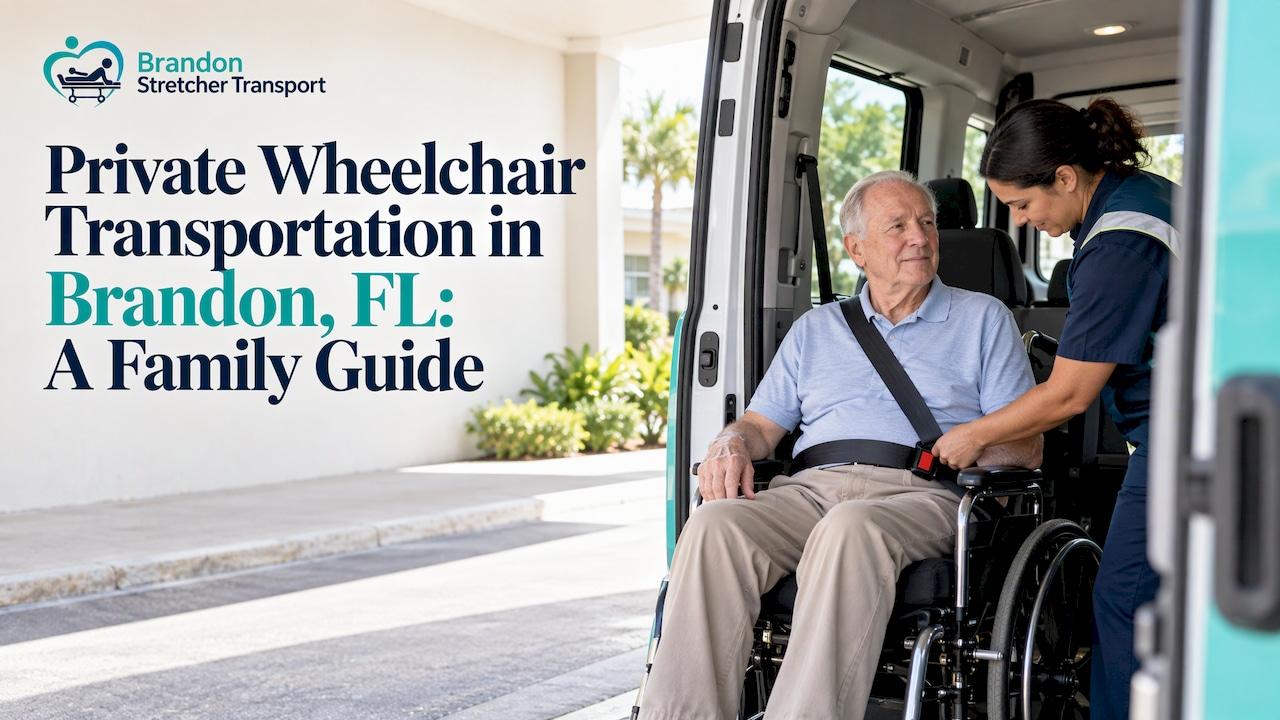
Private wheelchair transportation is a scheduled, non-emergency ride in a wheelchair-accessible vehicle that you book and pay for directly. It suits people who cannot safely get into a regular car, and it works well for medical appointments, dialysis, and moves between hospital, rehab and home. At Brandon Stretcher Transport, we provide private-pay wheelchair and stretcher rides in Brandon, Valrico, Riverview, Bloomingdale, Seffner and greater Hillsborough County, daily from 5 AM to 11 PM.
TL;DR
- Private wheelchair transportation is non-emergency, pre-booked and paid by the family or facility, not an ambulance and not a taxi.
- Check the basics before every ride: how the chair is secured, who helps with transfers, and whether help continues inside the destination.
- Costs depend on distance, time of day and level of assistance, so ask for a written quote before the ride.
- Brandon Stretcher Transport is private pay only. We do not bill Medicare or Medicaid.
- We are available daily from 5 AM to 11 PM. Call 813-937-9574 for a personalized quote.
Table of Contents
- What private wheelchair transportation is
- Who uses private wheelchair transportation
- What to check before you book
- Bedside-to-bedside help
- Planning a hospital or rehab discharge ride
- Preparing the passenger for a smooth ride
- What private wheelchair transportation costs
- Insurance, Medicare and Medicaid
- Our perspective
- How Brandon Stretcher Transport can help
- FAQ
- Sources
What private wheelchair transportation is
Think of it as the middle ground between a family car and an ambulance. The passenger stays in a wheelchair or transfers into a seat, rides in a vehicle equipped to carry mobility devices, and is helped by trained staff at both ends.
It is generally grouped under non-emergency medical transportation (NEMT) rather than ambulance transport, and it is usually a door-to-door or scheduled service for people who cannot transfer into a standard vehicle. An ambulance is for emergencies or for patients who need medical monitoring on the way. A private wheelchair ride is for the patient who is stable but needs a safe, assisted way to get somewhere.
How it differs from a taxi or rideshare
A taxi driver is not expected to secure a wheelchair, help on stairs or walk a passenger through a lobby. A private medical transport crew plans for exactly that. The ride is booked ahead, the passenger's needs are discussed before pickup, and the vehicle is chosen to fit.
How it differs from a stretcher ride
Wheelchair transport is for people who can sit upright for the trip. Stretcher (gurney) transport is for people who must stay lying down, for example after surgery, with severe weakness, or when sitting is painful or unsafe. Our stretcher trips always have a dedicated two-person crew. If you are unsure which fits, describe the situation when you call and we will help you choose.
Who uses private wheelchair transportation
The people who call us most often fall into a few groups:
- Families coordinating elder care. An adult child who cannot leave work, or who cannot lift a parent safely, books the ride and often pays privately.
- Hospital discharge planners and case managers. A patient is medically ready to go but has no safe way home or to rehab.
- Skilled nursing and rehab admissions coordinators. A new resident needs to arrive on a set day and be helped inside.
- Dialysis center social workers. Patients need reliable, repeated rides several times a week.
- Assisted living directors and home health or hospice case managers. Residents and clients need appointments, specialist visits and procedures.
The passenger may use a manual chair, a power chair, or a transport chair. Some can stand and pivot with a little help. Others need hands-on assistance for the whole transfer. Tell the dispatcher everything up front: the type of chair, how much it weighs, whether the person can bear weight, and any conditions like dementia, oxygen use or pain with movement. For passengers who need bariatric transport, we quote individually so the right equipment and crew are in place.
What to check before you book
Not every provider does the same job. These are the questions that separate a smooth ride from a stressful one.
1. How is the wheelchair secured?
This is the most important safety question. In the US, the four-point tiedown is the standard method: four straps, two at the front of the frame and two at the rear, each tied to anchors in the floor. A separate lap and shoulder belt secures the passenger.
The belt matters as much as the straps. A New York State oversight report notes that improper or incomplete use of lap and shoulder belts is one of the main reasons people in wheelchairs are hurt in vehicle accidents, since a poorly secured person can slide under the lap belt or be thrown from the chair. The same report found staff were not always trained in securement. So ask the provider directly who has been trained to secure a chair and the passenger, and how.
2. Who helps with transfers and entry?
Some services stop at the curb. Ask whether the crew will help the passenger out of bed or chair at the start, and whether they go inside at the other end. A ride that ends at the lobby can leave a frail passenger waiting alone at a crowded entrance.
3. Is the crew sized for the passenger?
A heavier passenger, a difficult stairway or a complex transfer may need two people. Say so when you book.
4. Is the price clear before the ride?
Ask for the total, and what could change it: distance, waiting time, stairs, after-hours pickup. A written or texted quote avoids surprises.
5. What are the service hours?
We operate daily from 5 AM to 11 PM. We are not a 24/7 service, so for a very late or overnight need, plan around those hours or arrange another type of care.
Bedside-to-bedside help
The phrase means the crew's job starts where the patient is, not at the front door. For a hospital discharge, that means helping the patient from the hospital bed to the stretcher or wheelchair, riding with them, and helping them into the receiving room at home or at the rehab facility. For a stretcher trip it is a dedicated two-person crew every time.

This matters most at transitions. A discharge day is busy: paperwork, medication instructions, family on the phone. Having someone handle the physical move, calmly and without rushing the patient, takes a real weight off everyone.
We help passengers through the door and into the destination, including facility admissions, and we communicate clearly with the family or coordinator about what is happening. We are independent. We are not affiliated with any hospital or rehabilitation facility, and we work with whatever facility your family or care team has chosen.
Planning a hospital or rehab discharge ride
Discharges rarely give much notice. Here is a workable sequence for families and planners.
- Call as soon as a discharge date looks likely. Even a tentative window lets us talk through the passenger's needs and your quote. We do not guarantee pickup times, but early planning gives the best chance of matching your schedule.
- Confirm wheelchair or stretcher. Ask the discharging nurse or therapist whether the patient can sit upright for the whole trip, and how long they can tolerate it.
- Share the details. Pickup room and floor, destination address, chair type and weight, oxygen or other equipment, stairs at home, and who will be there to receive the patient.
- Confirm who pays and who is the contact. Our rides are private pay. The payer and the person coordinating may be different people, so name both.
- Pack for the ride. Medications, discharge papers, ID, a blanket, glasses or hearing aids, and any cushion the patient normally uses.
- Prepare the destination. At home, clear the entryway and make sure the bed or chair is ready. At rehab, tell admissions the patient is on the way.
- Plan the return. For a recurring or appointment ride, book the trip back at the same time.
Trips to Tampa medical facilities
Many Brandon-area patients are treated in Tampa, whether at a major hospital, a specialist office or a cancer or imaging center. Longer trips need a little more planning: confirm the appointment time and the building, allow for traffic on the way, and tell us about any waiting or return needs so the quote is accurate. We also serve routine local trips around Brandon, Valrico, Riverview, Bloomingdale and Seffner.
Preparing the passenger for a smooth ride
The passenger is the most important person in the process, and often an anxious one. A few small steps help:
- Tell them the day before who is coming and about when.
- Dress them in comfortable layers that are easy to adjust. Vehicles can feel cool or warm.
- Use the restroom shortly before pickup if possible.
- Keep medications, a water bottle and any comfort items within reach.
- For a person with dementia, a familiar family member's voice, a simple explanation and an unhurried crew help a great deal. Tell the dispatcher about it in advance.
- Make sure someone expects them at the other end.
For dialysis and other recurring care, consistency helps. See our guide to dialysis patient transportation in Brandon for how to plan a standing schedule, and our overview of medical transportation for elderly loved ones for broader family planning.
What private wheelchair transportation costs
Prices vary by company and situation. Nationally, out-of-pocket wheelchair van rides commonly start with a base pickup and loading rate from about $25 to over $100 plus per-mile charges, and weekend, holiday and after-hours trips often add surcharges. A 2026 report says mileage fees have climbed to roughly $3.50 to $5.00 per mile in most metro areas. Treat those as national background, not a quote for Brandon.
What moves the price:
| Factor | Why it matters |
|---|---|
| Distance | Longer trips, such as into Tampa, cost more than local ones |
| Time of day and day of week | Early, late or weekend rides can be priced differently |
| Level of assistance | Stairs, heavy transfers or help inside a facility take crew time |
| Wait or return time | Waiting at an appointment or a round trip changes the total |
| Equipment and passenger needs | Stretcher and bariatric trips need different crews and equipment |
We do not publish a fixed rate sheet. Each ride is quoted individually and upfront, so you know the amount before you book. Our guide to what families pay for medical transport goes deeper on the numbers.
Insurance, Medicare and Medicaid
This is where many families get stuck, so we will be plain. Brandon Stretcher Transport is private pay only. We do not bill Medicare, Medicaid or insurance.
For context on the wider picture: Original Medicare generally does not cover routine non-emergency medical transportation, and covers ambulance transport only when it is medically necessary and other transport would endanger the patient's health. Some Medicare Advantage plans may offer limited transportation benefits, so check the plan's own materials.
In Florida, Medicaid non-emergency transportation requires prior approval by the member's managed care plan, or by the contracted transportation broker for members not in a managed care plan. If your loved one has Medicaid and wants a covered ride, contact the plan or broker. If you need a ride that is private, flexible and arranged directly, that is what we do.
Many families choose private pay when they need a specific day or time, bedside-to-bedside help, or a ride that insurance will not arrange quickly. Read more in our guide to private medical transportation in Brandon.
Our perspective
We have seen the same pattern many times. A family is told the discharge is today, the patient is tired, and nobody has worked out how the person will physically get from the bed to the destination. The ride itself is the easy part. The hard part is the handoff at each end.
That is why we built our service around bedside-to-bedside help. For stretcher trips, two crew members are on every ride. We help the passenger through the door and into the facility, rather than leaving them at the curb. We explain what is happening to the family in plain language.
We also believe in upfront, private-pay pricing. You should know what a ride costs before it happens, and the person booking should not have to untangle billing rules in the middle of a hospital discharge. We serve Brandon, Valrico, Riverview, Bloomingdale and Seffner because this is our community, and we want those rides to feel calm.
Wheelchair
How Brandon Stretcher Transport can help
If your loved one needs a safe, assisted ride, we offer private-pay wheelchair and stretcher transportation, hospital and rehabilitation transfers, recurring dialysis rides, medical appointment trips and individually quoted bariatric transport. Our crews help passengers from bedside to bedside, and we are available daily from 5 AM to 11 PM.

You can see the full list of services on the Brandon Stretcher Transport homepage, or call us to describe your situation and get a personalized quote.
FAQ
Is private wheelchair transportation the same as an ambulance?
No. An ambulance responds to emergencies or carries patients who need medical care on the way. Private wheelchair transportation is a scheduled, non-emergency ride in an accessible vehicle for stable passengers who need help getting around. If someone has a medical emergency, call 911.
Can a wheelchair passenger ride if they cannot sit up for the whole trip?
That depends on the person's condition. If sitting upright for the trip is painful or unsafe, a stretcher ride may fit better. Ask the patient's nurse or doctor, then tell us the details when you call. We will help you choose the right type of transport.
Do you accept Medicare or Medicaid?
No. Brandon Stretcher Transport is private pay only and does not bill Medicare, Medicaid or insurance. We provide an upfront quote so the payer knows the amount before the ride.
Do you go into the building with the passenger?
Yes. We offer bedside-to-bedside assistance, including help into and through the destination and with facility admissions. Tell us the address, floor and any stairs when you book so we can plan the trip.
What hours can I book?
We are available daily from 5 AM to 11 PM. We are not available around the clock. For a hospital discharge, call as early as you can so we can plan the ride, although we cannot guarantee a specific pickup time.
Sources
- Wheelchair Van Transportation Services: Types and Coverage
- Wheelchair Securement Standards: What Every Caregiver Must Know
- Wheelchair Securement, New York Justice Center
- Medical Transport Costs Are Increasing for Non-Emergency Rides
- Florida AHCA Medicaid State Plan Attachment 3.1-D
Call Brandon Stretcher Transport at 813-937-9574 for a quote.