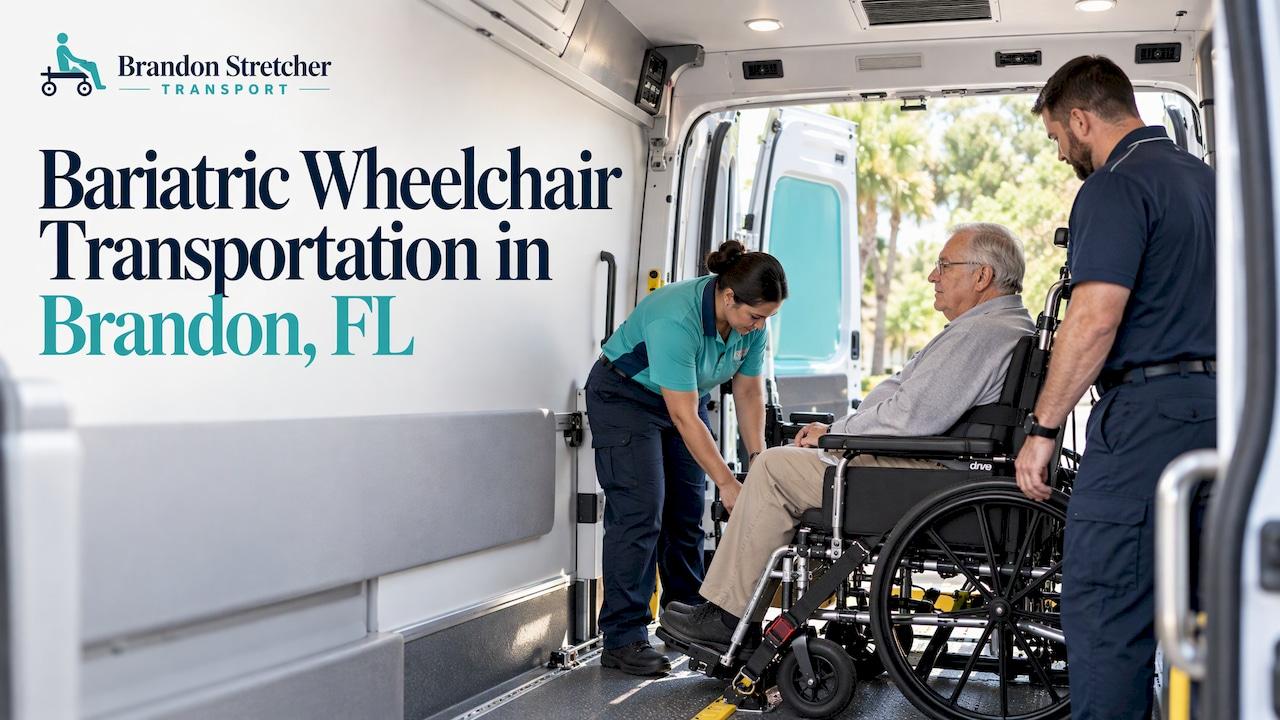
Bariatric wheelchair transportation is a non-emergency ride for a person who uses an oversized wheelchair, or who needs extra room and extra hands to travel safely. In Brandon and greater Hillsborough County, Brandon Stretcher Transport provides private-pay wheelchair and stretcher transportation with bariatric rides quoted individually, so the price and the plan fit the actual person, chair and destination. This guide explains how to size a ride, what the federal rules say about oversized wheelchairs, and what to have ready before you call.
TL;DR
- Bariatric wheelchairs commonly run 34 to 48 inches wide, so the vehicle, ramp or lift and doorways all have to be matched to the chair, not just to the rider's weight.
- Federal rules require many transit vehicles to carry larger and heavier wheelchairs when the lift and vehicle can handle them, and securement systems must limit movement of an occupied chair to 2 inches.
- Have the rider's weight, height, chair measurements, destination details and any stairs or tight entries ready before you request a quote.
- Brandon Stretcher Transport is private pay only, runs daily from 5 AM to 11 PM, and quotes bariatric transport individually. We do not bill Medicare, Medicaid or insurance.
Table of Contents
- What bariatric wheelchair transportation means
- Wheelchair, stretcher or something in between
- What the rules say about oversized wheelchairs
- What to prepare before the ride
- How Brandon Stretcher Transport handles bariatric rides
- Where we drive: Brandon, the surrounding communities and Tampa
- Paying for bariatric transportation
- Perspective
- FAQ
- Sources
What bariatric wheelchair transportation means
The word "bariatric" describes equipment and care designed for larger bodies. In transportation, it usually shows up in three ways: a wider or heavier wheelchair, a lift or ramp rated for more weight, and more people available to assist at the door, on the ramp and at the destination.
Size is the first practical issue. The ASPH Bariatric Safe Patient Handling and Mobility Guidebook lists bariatric wheelchairs at 34 to 48 inches wide and up to 52 inches long. Electric models are typically 39 inches wide and 44 to 49 inches long, and they need at least a 6-foot turning radius. A chair that size does not turn in a hallway, a narrow elevator or a standard vehicle doorway the way a standard chair does.
The same guidebook treats any patient over 300 pounds, or 100 pounds over ideal weight, or with a BMI over 40 as a person whose handling increases risk for caregivers. That is why bariatric trips are planned rather than improvised: the chair, the people helping and the path from room to vehicle all matter.
Bariatric wheelchair transportation differs from other bariatric medical transportation mainly in how the person travels. A wheelchair ride is for someone who can sit upright for the trip. A stretcher ride is for someone who needs to lie flat. Many people move between the two over time, for example after a hospital stay, so it helps to book with a provider that offers both.

Wheelchair, stretcher or something in between
Public program handbooks describe the same ladder of service levels. Virginia's Medicaid transportation handbook, for example, separates wheelchair van service from van-stretcher and stretcher service: wheelchair van is for people who cannot safely transfer out of a wheelchair, and stretcher levels are for people who need to be transported lying down. The point carries over to private rides in Florida: the right level depends on how the person sits, transfers and tolerates travel.
Here is a plain way to sort it:
| Situation | Likely fit |
|---|---|
| Rider stays in their own oversized wheelchair and can sit for the trip | Wheelchair transportation |
| Rider cannot sit upright for the trip, or is leaving the hospital and needs to stay flat | Stretcher transportation |
| Rider is heavier or wider than standard equipment allows | Bariatric transportation, quoted individually |
| Rider goes to dialysis or recurring appointments several times a week | Recurring ride schedule |
At Brandon Stretcher Transport, every stretcher transport has a two-person crew. For a discharge planner or a family member, that matters most at the handoffs: bed to stretcher, stretcher to vehicle, vehicle to the destination bed or room. Our bedside-to-bedside service includes help into the facility, so the ride does not end at the curb.
If you are not sure which level applies, describe the person's day-to-day mobility when you call. The right mode of transportation follows from how they transfer, how long they can sit and what the destination looks like. Our guide to private wheelchair transportation in Brandon walks through the wheelchair side in more detail.
Ordinary private car services are a different category. A black car or airport limo service is built for passengers who can step in and out of a seat, which is why a rider who needs a ramp, a securement system or hands-on transfer help belongs with medical transportation.
What the rules say about oversized wheelchairs
Three sets of standards shape how a wheelchair rides safely. None of them replaces a conversation with the provider, but they tell you what a safe setup looks like.
Vehicle and lift capacity. Under federal accessibility rules, vehicles must accommodate an occupied wheelchair weighing at least 600 pounds and measuring 30 by 48 inches, and many vehicles and lifts are built for larger and heavier chairs. The Department of Transportation's rule at 49 CFR Part 37 adds that covered entities must carry a wheelchair and its occupant if the lift and vehicle can accommodate them, even if the combination is larger or heavier than the design standard. Those rules apply to covered public transportation entities; they show the benchmark that wheelchair transportation is measured against.
Securement. The U.S. Access Board's standard requires that a securement system hold the wheelchair facing the front of the vehicle and limit movement to 2 inches in any direction under normal operating conditions. For vehicles under 30,000 pounds gross weight, each wheelchair position must restrain a forward force of at least 5,000 pounds-force. The NMEDA guidelines for 2026 go further on components, calling for securement systems that comply with SAE J2249 and RESNA WC-18, with parts rated at a 6,000-pound minimum for unoccupied chair securement.
Crash-safety standards. Federal motor vehicle standards 208, 209 and 210 cover seat belts and anchorages, and FMVSS 403 and 404 cover wheelchair lifts and their installation, according to a fleet safety guide from Chubb Risk Engineering.

For a family, the takeaway is simple. A safe ride has a chair that is secured at fixed points, the rider belted, a ramp or lift that fits the chair's size and weight, and trained people operating it all. A documented securement routine and annual refresher training are what fleet safety guidance recommends for providers, so those are reasonable things to expect from anyone who handles your family member.
What to prepare before the ride
Most problems on bariatric trips are measurement problems, found too late at a doorway. A few minutes of preparation prevents them. Gather this before you call:
- Weight and height. The ASPH guidebook says weight, height and waist measurements should be collected to select appropriate equipment. Give the real numbers, not estimates, so the quote and the equipment match.
- Chair details. Width, length, whether it is manual or power, and approximate weight with the rider in it. A power chair is longer and heavier than a manual one.
- Whether the rider transfers. Can they stand, pivot or bear weight at all? Or are they fully dependent? Lifting guidance from the VA algorithms says that when a caregiver would have to lift more than 35 pounds of a patient's weight, the patient should be treated as fully dependent and assistive devices used. Families should never attempt a heavy lift at the curb.
- Pickup and drop-off access. Stairs, steps, narrow hallways, elevators, gate codes, parking and the distance from the door to the room.
- Destination and appointment time. Name the facility, the department or unit, and the appointment time, so the plan works backward from when you need to arrive.
- Medical paperwork. For discharge trips, have the discharge orders and any care instructions travel with the patient.
- Supplies and companions. Oxygen, cushions, medication and whether a family member is riding along.
Case managers and discharge planners will recognize this list as the information they already have on the chart. Passing it on at the time of the call lets us give an accurate individual quote.
How Brandon Stretcher Transport handles bariatric rides
Brandon Stretcher Transport provides non-emergency stretcher and wheelchair transportation in Brandon and surrounding areas, with bariatric transportation quoted individually after we learn about the rider. Every stretcher transport has a dedicated two-person crew, and our bedside-to-bedside service includes assistance into the facility, so the person is supported from the room they leave to the room they arrive at.
We serve hospital and rehabilitation transfers, recurring dialysis rides and medical appointments. Our pricing is upfront and private pay, and we are available daily from 5 AM to 11 PM. Call to request a personalized quote, or see our stretcher, wheelchair and transfer services.

If the ride is part of a hospital discharge, our guide to non-emergency medical transportation in Brandon explains how a transfer is typically arranged.
Where we drive: Brandon, the surrounding communities and Tampa
We serve Brandon, Valrico, Riverview, Bloomingdale and Seffner, along with greater Hillsborough County. Typical trips look like this:
- Hospital to rehabilitation. A patient leaving an acute-care bed for a skilled nursing or rehabilitation facility, with the crew helping at both ends.
- Hospital to home. A discharge to a house in Valrico or Riverview, where the crew's help reaches the door and inside, so the family is not left to manage a transfer alone.
- Home to dialysis. Recurring rides on a set schedule. Our dialysis transportation planning guide covers what to set up.
- Appointments in Tampa. Specialist visits and procedures at Tampa medical facilities, such as Tampa General Hospital or Moffitt Cancer Center. We are not affiliated with any hospital or rehabilitation facility; we simply bring patients to the address on their paperwork.
- Assisted living and facility moves. Residents going to appointments or relocating between facilities.
Distance, wait time and the rider's needs all shape a quote, which is why we give it individually instead of publishing a flat bariatric rate. Our family guide to medical transport costs in Brandon explains what goes into pricing.
Paying for bariatric transportation
Brandon Stretcher Transport is private pay only. We do not bill Medicare, Medicaid or insurance, and the person or family booking the ride pays us directly. Our quote is given up front, before the ride, so a family member or facility knows the cost when they decide.
Public programs handle transportation differently. CMS describes the Medicaid transportation assurance as a requirement that states ensure beneficiaries with no other means of transportation can reach covered care, not a promise that any particular ride is paid for. Whether a given program applies to your family member is a question for their plan or caseworker. If you are paying privately, we are who you call.
Private pay can suit situations where timing matters, such as a discharge that needs to happen the same day, or a family that wants one crew to handle a pattern of rides. Our overview of private medical transportation in Brandon goes further. If you are arranging care for a parent, our guide to medical transportation for elderly loved ones may help.
Perspective
Most families call us after the measurements have already caused a problem: a chair that does not fit through a door, a transfer that took more hands than anyone planned for, a ride booked for the wrong level of care.
Our view is that a bariatric ride should be planned around the person, not squeezed into a standard service. That is why we quote bariatric transport individually, why every stretcher trip has a two-person crew, and why our bedside-to-bedside service includes help into the facility. The ride is not finished when the vehicle stops.
We also believe in saying the price first. Families paying privately are already carrying a lot. An upfront quote and a clear conversation about what the rider needs let them focus on the person they are caring for.
Wheelchair
FAQ
How wide a wheelchair can a bariatric ride accommodate?
Bariatric wheelchairs range from 34 to 48 inches wide, according to the ASPH guidebook. Because each rider and chair is different, we quote bariatric transport individually. Have the chair's width, length and weight, and the rider's weight, ready when you call.
Is a wheelchair ride or a stretcher ride right for a hospital discharge?
It depends on whether the patient can sit upright for the whole trip and transfer safely. If they need to lie flat, stretcher transportation fits, and our stretcher trips always have two crew members. Tell us the discharge orders and mobility level and we will help you match the ride.
Does Brandon Stretcher Transport accept Medicare or Medicaid?
No. We are private pay only and do not bill Medicare, Medicaid or insurance. You receive an upfront quote and pay us directly for the ride.
What hours do you drive?
We are available daily from 5 AM to 11 PM. Call to discuss your timing and request a personalized quote.
Do you go to Tampa?
Yes, we can take riders from Brandon, Valrico, Riverview, Bloomingdale, Seffner and greater Hillsborough County to Tampa medical facilities. Give us the facility name, the unit and the appointment time when you call.
Sources
- ASPH Bariatric Safe Patient Handling and Mobility Guidebook
- Virginia DMAS NEMT Member Handbook
- National RTAP ADA Toolkit: Mobility Devices Accommodation
- eCFR: 49 CFR Part 37
- 36 CFR Appendix A to Part 1192
- NMEDA QAP-103-2026 Guidelines
- Chubb Risk Engineering: Wheelchair Securement for Transport
- Medline Safe Patient Handling and Movement Instructions
- CMS SMD 23-006: Assurance of Transportation
- Niagara Falls Airport Limo Service
Call Brandon Stretcher Transport at 813-937-9574 for a quote.