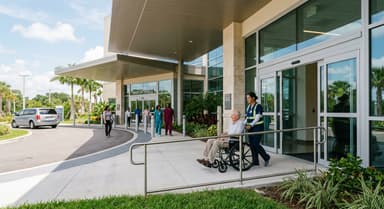

If the patient can walk to a car, a standard ride may be enough. If they need a wheelchair or stretcher, or help through the door, the ride to chemotherapy needs a crew that can lift, secure and escort them. Brandon Stretcher Transport provides private-pay stretcher and wheelchair rides across Brandon, Valrico, Riverview, Bloomingdale, Seffner and greater Hillsborough County. A dedicated two-person crew is on every stretcher trip, and the ride is bedside to bedside, including help into the facility.
This guide is for families, discharge planners and case managers who have to get a weakened patient to infusion, chemotherapy or radiation appointments, including to Tampa cancer centers. It covers how to decide what level of transport is needed, what to arrange in advance, and how to plan a recurring schedule.
TL;DR
- Match the ride to the patient's condition: a person who cannot walk from the curb to the treatment chair without hands-on help needs more than a rideshare or curb-to-curb van.
- Brandon Stretcher Transport is private pay only. We do not bill Medicare, Medicaid or insurance, and we quote each trip individually: call 813-937-9574.
- We serve Brandon and surrounding areas daily from 5 AM to 11 PM. We are not a 24/7 service, so schedule treatment-day rides inside that window.
- For a course of treatment, set up a repeating schedule with the same provider, and give the crew the appointment time, the unit and any equipment such as oxygen or an IV pole.
- Free volunteer driver programs and insurance benefits usually have rider requirements that a stretcher patient will not meet.
Table of Contents
- Who needs more than a standard ride to treatment
- Why curb-to-curb rides fall short for treatment days
- What bedside-to-bedside means on a treatment day
- Planning rides to Tampa cancer centers from Brandon
- What to arrange before the first ride
- Setting up a repeating schedule
- Paying for the ride
- Questions to ask any transport service before booking
- Wheelchair rides for patients who can sit up
- Promo: Rides from bed to treatment chair and back
- Our perspective
- FAQ
- Sources
Who needs more than a standard ride to treatment
Chemotherapy does not always leave a patient able to walk steadily. Fatigue, nausea, neuropathy, low blood counts, a recent hospital stay or a decline in an older patient can turn a ten-minute walk from the parking lot into a barrier. The practical question is not the diagnosis. It is what the patient can do alone.
OncoLink, the patient education service run by the University of Pennsylvania's cancer program, tells patients to consider whether they can walk from the parking area or transit stop and whether they need help doing it. That one question sorts most cases:
| What the patient can do | Typical level of ride |
|---|---|
| Walks independently, tires easily | Standard car, with a family member or a driver nearby |
| Walks only with a person's arm or a walker | Hands-on assistance, often a wheelchair ride |
| Cannot walk, sits safely in a wheelchair | Wheelchair transportation with help through the door |
| Cannot sit up for a trip, or is recovering from a hospital stay | Stretcher transportation with a two-person crew |
If you are unsure which row fits, the discharge planner, oncology nurse or social worker who knows the patient's mobility is the right person to say. When you call us, describe what the patient can and cannot do in plain terms: can they stand, bear weight, sit for 30 minutes, climb steps. That tells us what crew and equipment the trip needs.
Why curb-to-curb rides fall short for treatment days
OncoLink notes that paratransit and wheelchair-van services are usually cheaper than ambulance transport, but they commonly stop at the curb, give limited hands-on help and do not supply a wheelchair. The rider generally has to reach the curb and get into the appointment independently.
For a patient who has just had hours of infusion, that gap matters most on the way home. The ride that got them in is not the ride that has to get them back, and the trip home is when they are least able to manage a lobby, an elevator and a front step.
Volunteer programs have rules of the same kind. The American Cancer Society's Road To Recovery rider guide states that riders must be ambulatory, must be at least 18 to ride alone, and must load any wheelchair or medical equipment themselves or with a caregiver. It also asks for at least 25 hours' notice and requires a cancer diagnosis. ACS's program page adds that availability varies by location and recommends calling several business days ahead.
Those are reasonable rules for volunteer drivers. They also mean a patient who needs a stretcher, or hands-on help with a wheelchair, needs a crew trained and equipped to do that work. That is the gap Brandon Stretcher Transport fills.

What bedside-to-bedside means on a treatment day
Most transport ends when the vehicle stops. Ours starts at the patient's bed or chair and ends at their destination, with assistance into the facility. For a chemotherapy or infusion trip that looks like this:
- At home or the facility. The crew meets the patient where they are, whether that is a bed, a recliner or a hospital room, and moves them onto the stretcher or into the wheelchair.
- In the vehicle. A two-person crew is on every stretcher trip, so one person is not lifting, driving and watching the patient at once.
- At the cancer center. We help the patient into and through the building, not just to the curb.
- The return trip. The same help runs in reverse, back to the bed or chair.
For discharge planners, the same pattern applies to a hospital-to-rehabilitation or hospital-to-home transfer. A patient who starts chemotherapy while in a skilled nursing or rehab setting can also be moved between the facility and the treatment center with the same crew and the same level of care.
Planning rides to Tampa cancer centers from Brandon
Many Brandon-area patients are treated at oncology practices and infusion suites in Brandon, and many travel to larger centers in Tampa, such as Moffitt Cancer Center on USF Magnolia Drive. A trip across Hillsborough County adds time on the road, and a patient on a stretcher cannot easily shift position in a long wait.
Three habits reduce stress on those trips:
- Ask the treatment center for the arrival time and the unit. Chemotherapy and infusion visits often involve lab work, a clinic visit and then the chair. Knowing where the patient is expected helps us plan the drop-off.
- Ask how long the visit is likely to last. Infusions vary widely. If you can tell us a likely end window, we can plan the return trip around it. We do not guarantee pickup times, and delays at the treatment center are common, so keep the center's schedule and our dispatch in contact.
- Plan the earliest and latest rides inside our hours. We run daily from 5 AM to 11 PM. A long infusion that finishes late in the evening needs a conversation about the return ride before the first appointment, not on the day.
We serve patients from Brandon, Valrico, Riverview, Bloomingdale and Seffner, and the rest of Hillsborough County. Tell us the pickup address and the treatment address when you call, and we quote the trip for that route.
What to arrange before the first ride
A first treatment day goes better when a few details are settled in advance. Give us this when you call:
- Patient's name, pickup address and any access issues (stairs, gate codes, narrow hallways, elevator)
- Destination name, address, building and floor or unit
- Appointment time, and whether the visit is chemotherapy, infusion, radiation or a clinic appointment
- Whether the patient needs a stretcher or wheelchair, and whether they can bear weight
- Equipment that travels with them: oxygen, an IV pole, a wheelchair of their own
- Who will meet the patient at the destination, and who is paying
- Weight and size, if bariatric transport is needed, since we quote bariatric trips individually
OncoLink points out that medical necessity factors such as inability to bear weight or non-portable oxygen needs can change which kind of transport is appropriate. If either applies, say so at the start, so we can plan the crew and equipment.
The patient does not have to be the one paying. Adult children, case managers and facility staff often book and pay on a parent's or resident's behalf. Tell us who the contact is and we will coordinate with them.
Setting up a repeating schedule
Chemotherapy usually runs as a course: weekly, every two or three weeks, or on a cycle that changes. Booking each ride at the last minute is where trips fall through, especially when the family is also managing work, medications and the patient's care at home.
A better routine:
- Get the treatment calendar from the cancer center, including likely dates for scans and lab visits.
- Call us with the full set of dates you know and tell us which are firm and which may shift.
- Ask the center to tell you early when an appointment moves, then pass that to us.
- Keep the same contact person for the whole course so changes reach us quickly.
This matters beyond convenience. Louisiana Medicaid's transportation manual, for example, says that when recurring chemotherapy is arranged through a standing order, the same provider should be used when possible, for continuity and to prevent missed treatments (Louisiana Department of Health). That is a Louisiana Medicaid rule, not a Florida one, but the reasoning applies to any patient: the same crew learns the patient's needs, the building and the routine. We use the same approach for recurring dialysis rides, and the planning steps carry over to chemotherapy.
Paying for the ride
Brandon Stretcher Transport is private pay. We do not bill Medicare, Medicaid or insurance, and we charge for each booked ride. We give an upfront quote before the trip and do not publish a flat rate, because the price depends on the route, the level of transport, the number of trips and, for bariatric patients, the individual requirements. Call us for a personalized quote.
It helps to know how coverage generally works, so you can plan the budget:
- Original Medicare covers ambulance transport only when the patient's condition makes other transportation contraindicated. Under federal rules, being bed-confined means unable to get up, walk or sit in a chair or wheelchair without assistance. For repeated non-emergency ambulance trips, a physician certification dated within 60 days before service is required, and supporting medical records are still needed (42 CFR Part 410, Subpart B).
- Chemotherapy itself is covered by Medicare in specified outpatient settings, generally with 20% of the Medicare-approved amount for treatment in a doctor's office or freestanding clinic, according to Medicare & You 2027. That covers the treatment, not the ride to it.
- Medicaid and Medicare Advantage transportation benefits depend on the state, the plan and its trip limits. The patient's plan or the cancer center's social worker can say what applies.
For families who choose to pay privately, the advantage is control. You pick the time, the level of assistance and the crew, and you know the price before the ride. Our guide to medical transport costs in Brandon explains what goes into a private-pay quote, and our private medical transportation guide covers how to book.
Questions to ask any transport service before booking
Whatever you choose, confirm the basics in writing or by phone:
- Is a trained crew with the right equipment assigned to this trip, and how many people?
- Does the service help the patient into the building, or stop at the curb?
- What does the quote include, and is it given before the trip?
- What hours does the service run, and what happens if the treatment runs long?
- Can the same crew or provider handle the whole course of treatment?
We answer each of those directly: two-person crews on stretcher trips, assistance into the facility, an upfront quote, daily hours from 5 AM to 11 PM, and recurring ride scheduling. Our guides to non-emergency medical transportation in Brandon and medical transportation for elderly loved ones go through more of the planning.
Wheelchair rides for patients who can sit up
Not every chemotherapy patient needs a stretcher. Many can sit in a wheelchair for the trip but cannot get out of the house, into a vehicle or through a cancer center lobby alone. Wheelchair transportation with assistance into and through the destination fits that patient. It also suits the day after treatment, when energy is low, and radiation visits that run daily for several weeks.

Our private wheelchair transportation guide explains how these rides are set up for families. If a patient's condition changes during treatment, move up from wheelchair to stretcher by telling us at the next booking.
Promo: Rides from bed to treatment chair and back
Brandon Stretcher Transport provides private-pay stretcher and wheelchair transportation in Brandon and greater Hillsborough County, with a dedicated two-person crew on every stretcher trip, assistance into facilities, recurring medical appointment rides and individually quoted bariatric transport. We run daily from 5 AM to 11 PM.

To set up a ride to chemotherapy, infusion or radiation, call us with the appointment details and we will quote the trip upfront.
Our perspective
Treatment-day transportation is a care task, not a convenience. A patient who has been weakened by treatment should not have to negotiate a curb, a lobby or a stairway on their own, and a family should not have to lift a loved one into the back seat of a car.
That is why we send two people on every stretcher trip and go bedside to bedside, with help into the facility. The crew's job does not end at the vehicle door. It ends when the patient is settled where they are going.
We are private pay and we say so first. Families and case managers can plan around a clear quote, given before the trip, instead of waiting on an approval process while a treatment date approaches. Our service serves Brandon, Valrico, Riverview, Bloomingdale, Seffner and greater Hillsborough County, daily from 5 AM to 11 PM.
If you are coordinating a course of treatment, call early and give us the whole schedule. A steady routine with the same provider is easier on the patient, and easier on you.
Wheelchair
FAQ
Do you take Medicare or Medicaid for rides to chemotherapy?
No. Brandon Stretcher Transport is private pay only and does not bill Medicare, Medicaid or insurance. We give an upfront quote for each trip, and you pay us directly. Families, case managers and facility staff can all book on a patient's behalf.
Can you take a patient on a stretcher to infusion or radiation appointments?
Yes. We provide stretcher transportation with a dedicated two-person crew on every trip, and we help the patient into the facility. Tell us the pickup address, the treatment center and the appointment time, and we will quote the ride. We also provide wheelchair rides for patients who can sit up.
Can you drive to Tampa cancer centers?
Yes. We serve Brandon and greater Hillsborough County, and we provide rides to medical appointments in Tampa. Give us the destination address and unit when you call, and we will quote the route. We cannot promise a specific pickup time, so share the center's schedule with us in advance.
What hours can I book a ride?
We are available daily from 5 AM to 11 PM. We do not operate around the clock, so plan morning appointments and late-day returns inside that window, and tell us early if a long infusion may run late.
How much does a ride to chemotherapy cost?
We do not publish a flat price because each trip depends on the route, the level of transport and the patient's needs. Call us and we will give you a personalized quote before the ride. See our guide to what families pay for medical transport for what shapes the price.
Sources
- Getting to Your Appointments | OncoLink
- Road To Recovery | American Cancer Society
- Your American Cancer Society Road To Recovery Rider Guide, 2025
- 42 CFR Part 410, Subpart B | eCFR
- Medicare & You 2027 | Medicare.gov
- Non-Emergency Medical Transportation | Louisiana Department of Health
Call Brandon Stretcher Transport at 813-937-9574 for a quote.