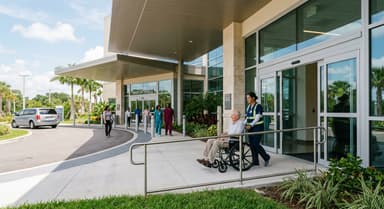
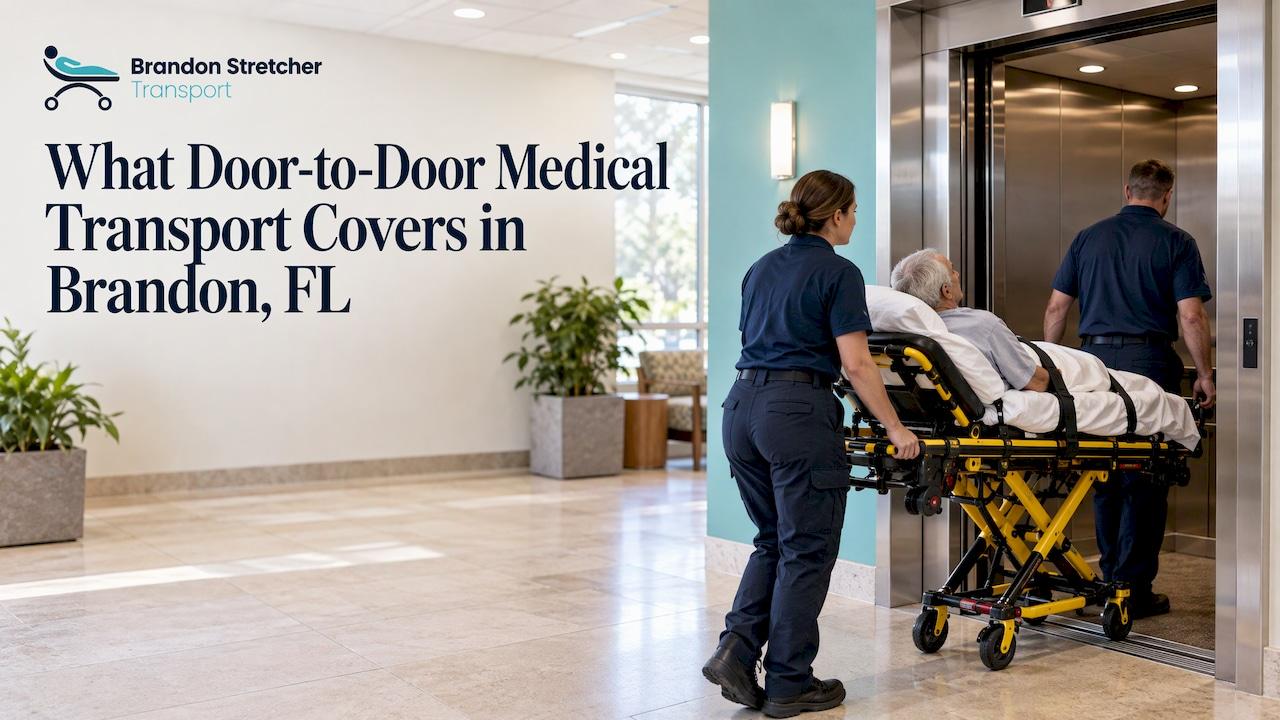
Door-to-door medical transport means a trained crew helps the patient from the pickup door to the vehicle and from the vehicle to the destination door. For patients who cannot walk safely or sit up, the service that actually protects them is bedside-to-bedside: the crew starts at the bed, goes through the door and ends inside the facility or home. Brandon Stretcher Transport provides private-pay stretcher and wheelchair rides across Brandon, Riverview, Valrico, Seffner, Bloomingdale and greater Hillsborough County, daily from 5 AM to 11 PM.
This guide explains the terms providers use, how to match the ride to the patient, how to coordinate a hospital discharge or recurring trip, and what to have ready when you call for a quote.
TL;DR
- Door-to-door usually means help to the outermost door. Door-through-door means help inside the building. Bedside-to-bedside goes one step further, from bed to bed.
- Patients who cannot sit, stand and transfer safely need a stretcher or wheelchair crew, not a taxi or rideshare.
- Brandon Stretcher Transport is private pay only. It does not bill Medicare or Medicaid. A two-person crew staffs every stretcher trip.
- Hospital discharges, rehab admissions, dialysis and recurring appointments are booked ahead. Call 813-937-9574 for a personalized quote.
Table of Contents
- What door-to-door medical transport actually means
- Stretcher, wheelchair or ambulatory: choosing the right ride
- The hospital discharge ride, step by step
- Recurring rides: dialysis, chemotherapy and appointments
- Paying for it: private pay in Brandon
- Why the two-person crew matters
- Who this serves
- Our service in Brandon and Hillsborough County
- Our perspective
- FAQ
- Sources
What door-to-door medical transport actually means
The words sound alike, but they describe different levels of help. The National Aging and Disability Transportation Center describes three levels: curb-to-curb (pickup at the curb or driveway), door-to-door (help entering and exiting the vehicle and possibly to the door) and door-through-door (help from the vehicle to the door of the residence or destination).
A 2024 industry standard from the NEMTAC group draws the line more precisely. Door-to-door is help to or from the outermost door at both ends. Door-through-door is help from inside the pickup location to the vehicle, and from the vehicle inside the drop-off location.
Why this matters: a driver who stops at the lobby door cannot help a patient who needs a stretcher, a lift or a transfer into a bed. If the person you are arranging a ride for cannot manage the lobby, the hallway or the stairs alone, ask exactly where the crew's help starts and ends.
How bedside-to-bedside differs
Bedside-to-bedside is how Brandon Stretcher Transport describes its service. The crew meets the passenger where they are, whether that is a hospital bed, a rehab room or a bed at home. They move the passenger safely to the vehicle and then assist into the destination. For a patient leaving a hospital, that removes the gaps where families usually end up improvising: the elevator, the front steps, the hallway to the room.
How it differs from an ambulance
An ambulance is for emergencies and for patients who need medical treatment or monitoring in transit. Non-emergency stretcher transport is for people who must stay lying down but are stable. Original Medicare Parts A and B limit transportation coverage to emergency ambulance services, which is one reason families and facilities book private non-emergency rides for planned trips.
Stretcher, wheelchair or ambulatory: choosing the right ride
The right vehicle depends on what the patient can do, not on the destination or on what is most convenient. Clinical guidance gives a useful checklist. Before moving a patient on foot, the British Columbia Emergency Health Services guideline says to assess pain, gait stability, vital signs, mentation and the ability to follow directions. The patient should be able to sit and balance, stand and balance, step in place and transfer the needed distance alone or with minimal help. If not, a stretcher or assistive device is the safer choice.
In practice:
| Situation | Usual fit |
|---|---|
| Can stand, walk short distances, needs an arm | Ambulatory or wheelchair with assistance |
| Stays seated, uses a wheelchair, needs securement and help over thresholds | Wheelchair transportation |
| Must lie flat, cannot sit up for the trip, or needs a bed-to-bed transfer | Stretcher transportation |
| Weight above standard equipment limits | Bariatric transport, quoted individually |
Ontario's provincial decision guide for stretcher services lists indicators such as needing to be flat, medical instability, a bed-to-bed transfer, or needing a stretcher to enter or leave the vehicle. It also says the team must plan for care needs both during the trip and at the receiving facility. Though written for Canada, the logic holds for any transfer.
If you are not sure, the discharge nurse, physical therapist or physician is the right person to say whether the patient can sit up for the trip. Tell us what they said when you call, and we will quote the ride that matches it.
The hospital discharge ride, step by step
Most of the calls we handle start with a discharge. The same sequence works for a family or a case manager.
- Confirm the level of mobility with the care team. Ask whether the patient can sit upright for the full drive and how they will transfer. Write down the answer.
- Fix the destination and the address details. Rehab and skilled nursing facilities, assisted living communities and homes all differ: stairs, elevators, gate codes, which entrance and which room. Brandon Stretcher Transport helps passengers into the destination, so the crew needs to know what the entry looks like.
- Book as soon as the discharge is likely. Discharges often move at short notice, so give the date as soon as you have it and tell us if it changes. We do not guarantee a pickup time, but the earlier we know, the better we can plan.
- Send the paperwork with the patient. Facility admission packets, medication lists and orders should go with the patient, not in someone's car.
- Have someone receiving at the destination. A relative or staff member who knows the patient is expected helps the handoff.
- Confirm the plan the day before. Re-check the time, the address and any equipment, such as oxygen the patient already uses.
The usual hospital-to-rehab trip within Hillsborough County can include destinations in Tampa. For example, Tampa General Hospital is at 1 Tampa General Circle, and HCA Florida Brandon Hospital is at 119 Oakfield Drive in Brandon. We name these only as locations riders commonly travel to or from. Brandon Stretcher Transport is an independent transport company with no affiliation with any hospital or rehabilitation facility.
When the ride home falls through
If a planned ride does not arrive, call the number you used to book it, explain the problem calmly, then tell the medical provider. That is the same advice federal CMS guidance gives to riders. If a family is stuck at discharge with no transport, call us on 813-937-9574. We will tell you honestly what we can arrange within our hours of 5 AM to 11 PM, seven days a week.
Recurring rides: dialysis, chemotherapy and appointments
Patients who need the same trip several times a week benefit from a plan rather than a daily call. Standing arrangements for dialysis and other recurring treatment usually mean the same pickup point, the same time and a return trip. Public programs set their own scheduling rules. Wisconsin Medicaid, for instance, defines a standing-order ride as regularly recurring transportation with the same pickup, time, destination and return. That structure is a good model for any family to follow.
When you ask us about a recurring schedule, tell us:
- the days and times of the appointments,
- how long treatment usually runs and when the patient will be ready,
- whether the patient is on a stretcher or in a wheelchair, and
- any stairs or entry issues at home.
For more on planning these trips, see our guides to dialysis patient transportation and chemotherapy transportation in Brandon.
Paying for it: private pay in Brandon
Brandon Stretcher Transport is private pay only. We do not bill Medicare, Medicaid or insurance. You pay us directly for each booked ride, and you get an upfront quote.
It helps to know why, so you can plan. Florida Medicaid does cover non-emergency transportation for eligible recipients, but the Agency for Health Care Administration says it applies to medically necessary trips when the recipient has no other available transportation to a Medicaid-compensable service. The state plan also requires prior approval from the managed-care plan or the state's contracted broker. Those are program rules we do not work under. If a patient's trip is covered that way, the plan or broker handles it. If you want to choose your own provider, set your own schedule or add help inside the facility, a private-pay ride is the route we offer.
On Original Medicare, 2026 ambulance services carry a 20% coinsurance after the $283 Part B deductible, and only where the ambulance is covered at all. Private-pay stretcher transport is a different service.

What affects the price
We publish no fixed rates, because the price depends on the trip. These are the factors that shape a quote:
- the ride type (stretcher or wheelchair) and whether bariatric equipment is needed,
- the pickup and drop-off addresses and the distance, including trips into Tampa,
- stairs, narrow doorways or long carries at either end,
- waiting time, round trips and the time of day, and
- how often the ride repeats.
When you call, give both addresses, the ride type, the appointment length and any stairs. Ask for the total before you book. Our guide to medical transport costs in Brandon walks through what families typically weigh.
Why the two-person crew matters
Every stretcher trip we run has two crew members. Safe transfer depends on trained people, the right equipment and clear communication of each step, which is how OpenStax's clinical nursing text frames moving a patient between bed, chair, stretcher and wheelchair. With two people, one can focus on the patient while the other manages the equipment, doors and route. A family member driving a car, or a single driver at the curb, cannot offer that.
Who this serves
We work with several kinds of callers, and each needs something slightly different:
- Families and adult children paying privately for a parent: a clear quote, plain communication and someone who goes inside with the patient.
- Discharge planners and case managers: one phone call to set up a transfer with an address, a mobility level and a time window.
- Rehab and SNF admissions coordinators: a crew who helps the patient into the facility rather than leaving them at the entrance.
- Dialysis social workers and hospice or home health case managers: repeat trips arranged around treatment schedules.
- Assisted living directors: transport for residents who can no longer use ordinary vehicles.
The need is real. A federal survey found about 6 percent of U.S. adults said lack of reliable transportation had kept them from medical appointments, meetings or work in the past 12 months. Urban Institute research found 17 percent of adults with disabilities had gone without needed care because of transportation difficulty.
Our service in Brandon and Hillsborough County
Brandon Stretcher Transport provides stretcher and wheelchair transportation with bedside-to-bedside assistance, facility admission help, hospital and rehab transfers, recurring dialysis and medical appointment rides, and individually quoted bariatric transport. We serve Brandon, Riverview, Valrico, Seffner, Bloomingdale and greater Hillsborough County. Visit our Brandon location page for details, or read about private medical transportation and transportation for elderly loved ones.
We are available daily from 5 AM to 11 PM. For a personalized quote, call or contact Brandon Stretcher Transport with the patient's mobility level, both addresses and the date.

Our perspective
Families rarely ask us for a vehicle. They ask whether their mother will be safe from her hospital bed to her new room, and whether anyone will go in with her.
That is why we built our service around bedside-to-bedside help and a two-person crew on every stretcher trip. A ride that ends at the curb leaves the hardest part to the people least equipped to do it.
We are private pay only. That lets us quote the ride upfront, communicate plainly and focus on the passenger in front of us. If you give us the mobility level, the addresses and the timing, we will tell you what the trip involves and what it costs before you decide.
Wheelchair
FAQ
What is the difference between door-to-door and door-through-door transport?
Door-to-door generally means help to or from the outermost door at each end. Door-through-door means the crew helps inside the building as well. Bedside-to-bedside, the way Brandon Stretcher Transport works, starts and ends at the patient's bed.
Does Brandon Stretcher Transport accept Medicare or Medicaid?
No. Our service is private pay only, and we do not bill Medicare, Medicaid or insurance. You pay directly for each booked ride after receiving an upfront quote.
How much does a ride cost?
The price depends on the ride type, the distance, stairs, waiting time and whether the trip repeats. Bariatric transport is quoted individually. Call 813-937-9574 for a personalized quote.
Can you take a patient to Tampa medical facilities?
Yes. We serve greater Hillsborough County, including trips from Brandon, Riverview, Valrico, Seffner and Bloomingdale into Tampa. Give us both addresses and the appointment time when you call.
What hours are rides available?
We are available daily from 5 AM to 11 PM. We do not offer round-the-clock service, so book ahead for early or late appointments.
Sources
- NADTC: Transportation Options for Mobility Independence
- NEMTAC Levels of Service Standard, 2024
- BCEHS: Ambulating Patients
- Ontario Stretcher Transportation Services decision guide
- OpenStax: Transferring Patients
- CMS: Let Medicaid Give You a Ride
- Wisconsin ForwardHealth: Types of NEMT Rides
- Florida AHCA: Non-Emergency Transportation Services
- Florida Medicaid state plan amendment 2021-0010
- Medicare Interactive: Part B costs
- AHRQ MEPS Statistical Brief 558
- Urban Institute: transportation barriers and forgone care
- Tampa General Hospital locations
- CMS: HCA Florida Brandon Hospital listing
Call Brandon Stretcher Transport at 813-937-9574 for a quote.