
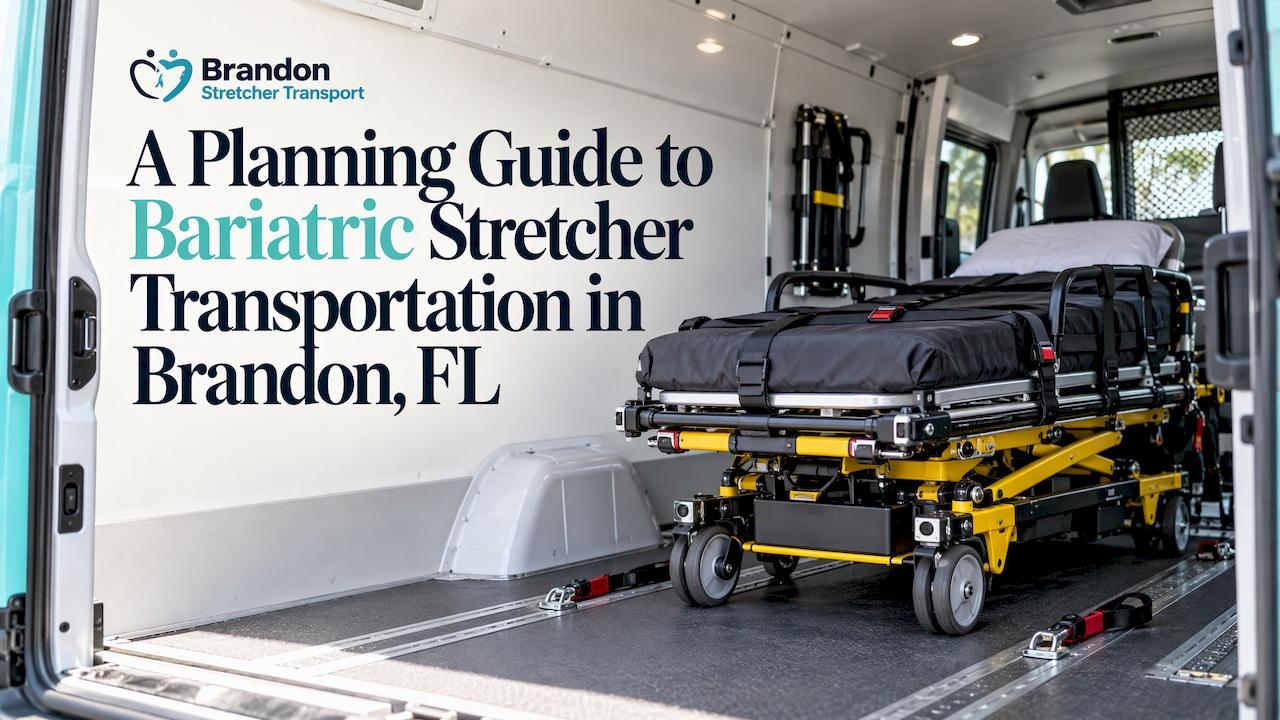
Bariatric stretcher transportation is non-emergency medical transport for a patient who must travel lying down and whose weight or body size calls for extra-wide, reinforced equipment and more hands. At Brandon Stretcher Transport, bariatric rides are quoted individually, travel with a dedicated two-person crew on every stretcher trip, and run bedside to bedside, so the patient is helped out of the room and into the destination, not just to the curb. Service is private pay and available daily from 5 AM to 11 PM.
This guide is for families, discharge planners, rehab admissions coordinators, dialysis social workers and facility directors in Brandon, Valrico, Riverview, Bloomingdale and Seffner who need to get a bariatric patient from one bed to another safely.
TL;DR
- Bariatric stretcher transport is for patients who cannot sit upright for a ride and need wider, reinforced equipment and extra crew. It is non-emergency: if the patient is unstable, call 911.
- Weight rating is only half the question. The VA's guidance says a stretcher can meet the weight capacity and still be too narrow for the patient.
- Have the patient's weight, height, mobility, oxygen or IV needs, and the stairs, doors and elevators at both ends ready before you call.
- Brandon Stretcher Transport is private pay only and does not bill Medicare or Medicaid. Bariatric trips are individually quoted, so call for a personalized quote.
- For discharges, book as early as you can. We do not guarantee pickup times, but early notice gives everyone room to plan.
Table of Contents
- What bariatric stretcher transportation is
- What to check on the equipment
- How a safe transfer is planned
- Where the stretcher stops and the help begins
- What bariatric transport costs and how to pay
- Booking: a short checklist
- Our approach to bariatric transport in Brandon
- Our point of view
- FAQ
- Sources
What bariatric stretcher transportation is
A standard stretcher trip moves a patient who cannot sit in a wheelchair, for example after a hospital stay, a stroke, a fracture or a long decline. A bariatric stretcher trip does the same for a patient whose weight, width or body shape means standard equipment may not fit or may not be rated for them.
Three things change:
- The stretcher. It needs a higher weight rating and more width.
- The vehicle. Doors, ramp or lift, and floor space must handle the load and the patient's size.
- The people. Lifting and rolling a larger patient through hallways, door frames and elevators takes more than one pair of hands and practiced technique.
Industry sources often use roughly 400 pounds as the point where bariatric transport comes into play, but the better test is whether the patient fits and is supported safely, not a single number.
Stretcher, wheelchair or ambulance?
The right level of transport depends on how the patient moves and how stable they are.
| Situation | Usually fits |
|---|---|
| Can sit upright, can transfer or be wheeled | Wheelchair transportation |
| Must lie flat or cannot safely sit for the ride, medically stable, no care needed in transit | Stretcher transportation |
| Larger body size and cannot sit for the trip | Bariatric stretcher transportation |
| Unstable, needs medical treatment during the trip, or is having an emergency | 911 and an emergency ambulance |
Some bariatric patients do fine in a wheelchair and a vehicle built for it. Provider Magazine's post-acute guidance notes that bariatric transport is not one-size-fits-all: some residents ride in a wheelchair van, while others need extensive planning for a specialist visit. If the patient can sit, our bariatric wheelchair transportation guide explains that option. If you are unsure which level applies, the discharging nurse, case manager or the patient's physician decides what the patient can safely do, and we can talk through the trip when you call.
What to check on the equipment
Families and care teams often ask for a single weight limit. The research points to a longer list.
Width, not only weight
The U.S. Department of Veterans Affairs' Bariatric Safe Patient Handling and Mobility Guidebook says stretchers may run up to 39 inches wide and 70 to 82 inches long, that a stretcher's width may not accommodate a bariatric patient, that its weight capacity must be confirmed, and that motorization is a must for bariatric patients. In plain terms: a cot rated for the patient's weight can still be too narrow, and a larger patient is hard to raise and lower safely without powered help.
Rated capacity in every position
A cot's rating can change with its position. One county EMS training manual, Dane County's 2022 bariatric ambulance manual, describes a bariatric cot rated to 1,600 pounds in the down position and up to 850 pounds in other positions, with added width, pull-out handles so more people can help, and longer straps. That is one agency's equipment, not a standard, but it shows why the question to ask is "what is the rating while the patient is being raised, lowered and loaded?"
Lifts, slings and securement
If a lift is part of the trip, the FDA's Patient Lifts Safety Guide tells caregivers to check the patient's weight against the manufacturer's guidelines, confirm lift and sling limits are not exceeded, look over slings for tears, holes and frayed seams, and not use a lift for transport unless it is designed for that. It also says to avoid lift use if the patient is agitated, resistant or combative, and to make sure the emergency release works.
Vehicle and crew
Provider Magazine suggests facilities ask whether staff are trained to move bariatric clients, whether the vehicle is built for it (doors wide enough, a ramp or lift that supports the weight, room for the patient and equipment), whether tie-down straps suit larger weights, and how the crew will communicate concerns to the facility. Those are good questions for any provider, and they are the ones we expect you to ask us.
How a safe transfer is planned
A bariatric trip is easier when the planning happens before the day. Work through these points with the transport team:
- Weight and height. Give both. Weight alone does not show whether the patient fits.
- How the patient moves. Can they bear weight, pivot or stand, or must they be moved fully lying down?
- Both ends of the trip. Steps, narrow doorways, tight hallways, elevators, and how far the vehicle can park from the door.
- Equipment and needs in transit. Oxygen, IV support, a ventilator, a service animal, or other needs that affect space and crew.
- Mental status. The patient should be able to understand and follow simple instructions, or a family member or staff member should be present to help.
- Timing. For discharges, the earlier the transport team knows, the better.
Public agencies use the same checklist. Tennessee's Medicaid program, in its hospital discharge scheduling guidance, asks for the patient's name and contact details, pickup and destination names, addresses and room numbers, the purpose of the trip, and, for bariatric transport, weight and height plus special needs like oxygen, IV support, stairs or service animals. That is a Tennessee program and does not apply to Florida private-pay rides, but the list is a useful template for any booking.
Where the stretcher stops and the help begins
Many bariatric trips go wrong not on the road but at the door. A patient is delivered to a lobby with no one to get them to the room, or a hospital bed has to be matched to a cot in a small room. This is why bedside-to-bedside matters.
Our crews provide door-through-door assistance, including help into the facility, and every stretcher transport has a dedicated two-person crew. For a bariatric patient, that means the person you hand off to at the bedside stays with the patient through the trip and the arrival.
Common Brandon-area trips
- Hospital to home. Discharges from hospitals in Brandon, Tampa and the surrounding area to a home in Valrico, Riverview, Bloomingdale, Seffner or elsewhere in Hillsborough County. Our hospital to home guide walks through that handoff.
- Hospital to rehab or skilled nursing. Admissions coordinators can plan the arrival time around therapy and intake schedules. See our hospital discharge transportation planning guide.
- Tampa medical facilities. Appointments and procedures at Tampa hospitals and specialty centers are part of what we are asked to cover. Tell us the facility name and address, and the entrance or department, when you call.
- Recurring dialysis and medical appointments. Standing rides on a regular schedule are available for dialysis and ongoing appointments.
What bariatric transport costs and how to pay
Brandon Stretcher Transport is private pay. We do not bill Medicare, Medicaid or insurance, and we do not publish a flat price for bariatric rides because each one is individually quoted. The quote reflects the specifics of the trip, so call us with the details above for a personalized quote. Our medical transport costs guide explains what families in Brandon typically weigh when budgeting.
For general context, Provider Magazine reports that bariatric transport costs can range from as little as $95 per visit up to $500 (2024), that insurance may reimburse some of the cost depending on the plan, and that in some cases the facility bears the full cost. Actual cost depends on distance, patient needs and equipment, so treat that range as a rough national reference, not a Brandon price.

Medicare and non-emergency stretcher rides

Medicare's ambulance rules are narrow. Medicare administrators describe a prior authorization program for repetitive scheduled non-emergent ambulance transports that covers certain ambulance codes, allows up to 40 round trips in 60 days per authorization, and requires a decision before the service is delivered. Medicare Advantage plans also require prior authorization for non-emergency ambulance transportation, and all services must be medically necessary. If you want a covered ambulance ride, those rules and your plan's own process govern it. If you want a private ride you can book directly, our service is paid by the family, the case manager or the facility at the time of booking, with no authorization step.
Booking: a short checklist
- Call as early as the discharge or appointment date is known.
- Give the patient's weight and height, and how they move.
- Give pickup and destination names, addresses, room numbers and phone numbers.
- Mention oxygen, IV support, a ventilator, a service animal, stairs or narrow access.
- Say who will meet the patient at the other end and who is paying.
- Ask for a personalized quote before the day of the trip.
Case managers and discharge planners can run this list in a few minutes, and it keeps bedside handoffs predictable. We are not affiliated with any hospital or rehabilitation facility; we are an independent private-pay transport service. Our private medical transportation guide and non-emergency medical transportation overview cover the wider picture.
Our approach to bariatric transport in Brandon
For a family paying privately, the biggest stress is not knowing what the day will look like. For a case manager, it is a handoff that falls apart halfway. Brandon Stretcher Transport was built around fixing both with upfront, private-pay pricing, a dedicated two-person crew on every stretcher trip, and help from the bedside to inside the destination.
Our bariatric trips are quoted individually, and you can reach us for a quote daily between 5 AM and 11 PM. Learn more about our stretcher, wheelchair and transfer services, or see our Brandon service page.

We serve Brandon, Riverview, Valrico, Seffner, Bloomingdale and greater Hillsborough County. We are not a 24-hour service, and we do not bill Medicare or Medicaid.
Our point of view
A bariatric patient is often the person other services are least ready for. Equipment that is too narrow, a crew that is too small, or a driver who leaves the patient at the curb can turn a discharge into a bad day for everyone.
We think the answer is simple. Send two people on every stretcher trip. Go bedside to bedside. Tell the family what the ride will cost before it happens. Those are the things we do, and we do them for patients of every size.
When you plan a bariatric transfer, ask the questions in this guide of whoever you book. Width, rating in every position, crew size, and who helps at the door. We would rather you ask them of us than not ask at all.
Wheelchair
FAQ
Is bariatric stretcher transportation an ambulance?
No. It is non-emergency transport for a patient who is medically stable but must lie down, with equipment and crew sized for a larger patient. If the patient needs treatment in transit or is having an emergency, call 911.
How much does it cost?
Brandon Stretcher Transport quotes bariatric rides individually and is private pay, so we do not publish a flat rate. Call 813-937-9574 with the patient's details and the pickup and destination for a personalized quote.
Do you accept Medicare or Medicaid?
No. We are private pay only and do not bill Medicare, Medicaid or insurance. Families, case managers and facilities pay directly for the ride they book.
What should I have ready when I call?
The patient's weight and height, how they move, pickup and destination addresses and room numbers, any oxygen, IV or ventilator needs, and any stairs or narrow access at either end. The more we know, the more accurate the quote.
Can you take a patient to a Tampa hospital or clinic?
Yes, Tampa medical facilities are part of the trips we are asked to cover. Give us the facility name, address and the department when you call, and we will quote the trip.
Sources
- Bariatric Safe Patient Handling and Mobility Guidebook, U.S. Department of Veterans Affairs
- Patient Lifts Safety Guide, U.S. FDA
- Bariatric Ambulance manual, Dane County EMS (2022)
- Transporting Bariatric Residents in the Post-Acute Setting, Provider Magazine (2024)
- NEMT Facilities and Hospital Discharge Scheduling, TennCare (2025)
- Prior Authorization Program for Repetitive Scheduled Non-Emergent Ambulance Transports, First Coast Service Options
- 2025 Medicare Prior Authorization Grid
Call Brandon Stretcher Transport at 813-937-9574 for a quote.